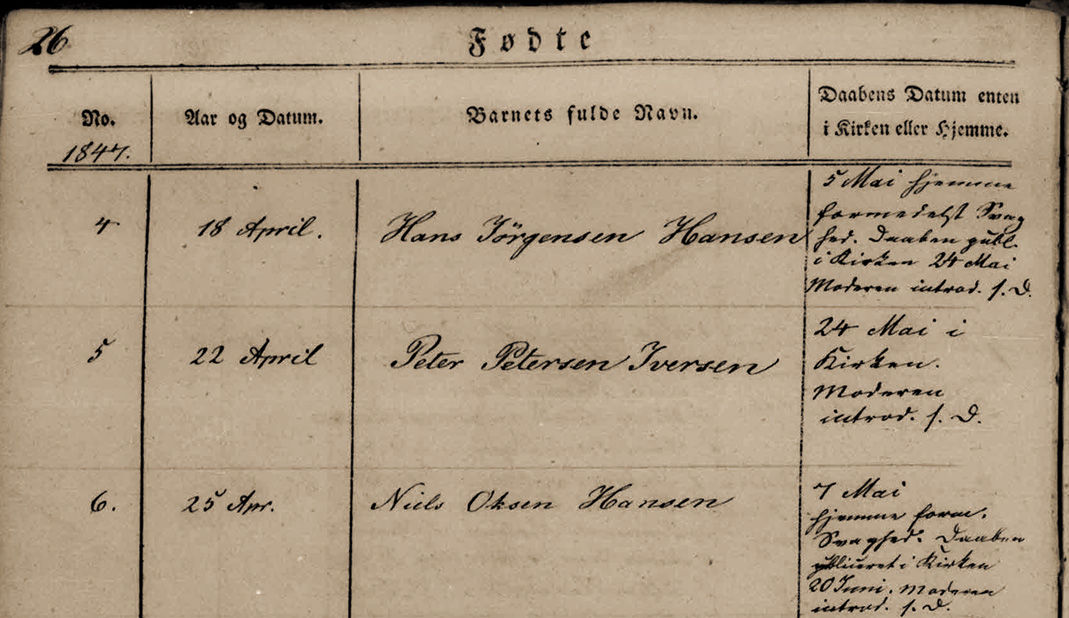
Henry's Birth Register entry
Henry was born Hans Joergensen Hansen on the April 18, 1847, at the family home Melbyvej 25 in Melby, Skaerbaek parish. He was the second child of Anders Hansen and Lena Marie Thorsdatter. He was baptized at home on May 5 and in church on Mary 24, 1847. Witnesses were Laust Andersen from Melby, Christen Rasmussen from Abild, Niels Carstensen Hollaender, Cathrine Marie J. Petersen’s wife and Marikke Marie Enemark, all from Melby.
The witness Laust Andersen (Boedcker) is interesting. He and his wife Karen lived in the house Melbyvej 23 next door to Anders Hansen. Laust Andersen’s profession was as a watch maker and jeweller, a trade he had learnt from his father in Rejsby. It is told that Laust Andersen was a large person with a big body, and people were wondering how he could work with delicate watches with his thick fingers. It is undoubtedly from this Jeweller/watchmaker living next door that young Henry Hansen learnt his trade as a jeweller.
It is not easy to say exactly where this house where Henry grew up in was, as it no longer exists. This we know from the book “Citizens of Skaerbaek around 1840”. However, in the census at that time, the house before Anders Hansen’s house has been identified as Melbyvej 23, and the house after Anders Hansen’s house has been identified as Melbyvej 27 (Melbyhus, see below). It follows from this, that the house Anders Hansen bought must have been equivalent to Melbyvej 25 and had been located on the grounds of this address.
In 1855, the family lived in a house in Melby and Anders Hansen was working as a tailor. Besides their children, there were to two servants in the family: Hans Nielsen Zimmerman (23 years old) and Christian Zander (17 years old).
In 1860, the family lived in a house in Melby and Anders Hansen was working as a tailor. Besides the four children, they had two servants: Hans P. Thyssen (25 years old) and Hans P. Petersen (23 years old).
In 1864, Denmark lost the Second Schleswig War to Germany and the Southern part of Denmark (Northern Schleswig) was divided between Germany and Denmark. This meant that Skaerbaek parish and many other parishes were now part of Germany which lasted until 1920. This was, of course, not an easy situation for the Danish people in the area.