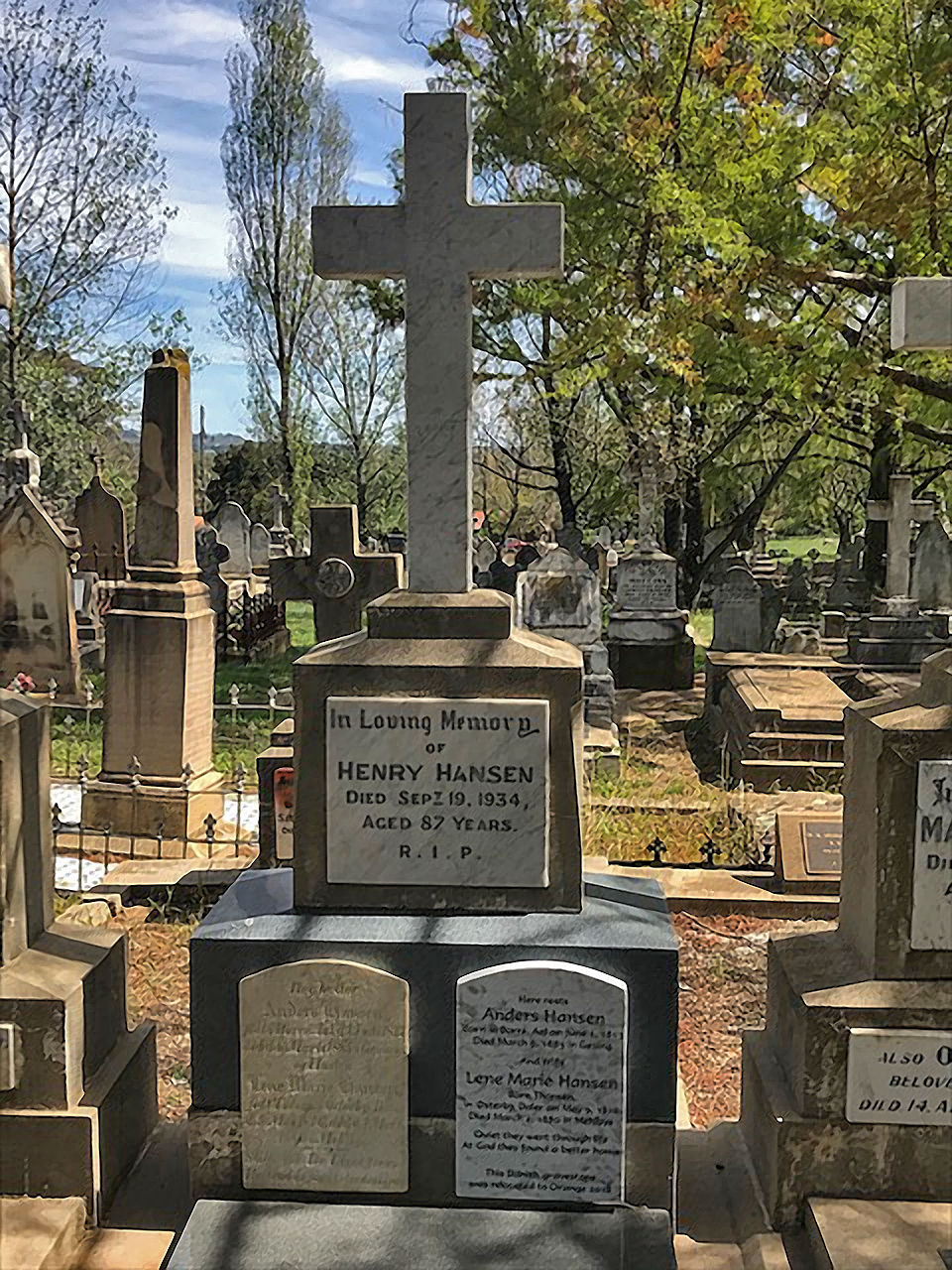
Henry Olaf Hansen 1847 - 1934

Compiled by Janet Hansen in 2016 from Henry’s obituary and the Joe Glasson articles with assistance from Marg Picken and Ivan Cunial. Joe Glasson’s articles are available on the Hansen website as are all the other photos and articles mentioned. Updated 2020.

Henry Olaf Hansen (Hans Joergensen Hansen)  

Henry was described in his obituary as “cultured, of noble character, of high and buoyant spirit, refined and with integrity. Cultured, keen in judgement, strong in mind and heart, his refinement and integrity were an example for all to follow. He was kind and charitable, which was often unknown to others.”


Margaret Picken, his granddaughter remembered him as "a very dignified, lovely old man". He was called “Old Dadda” by his grandchildren. Marg visited him regularly in the last few years of his life and he always gave her 6 pence. He lived in a bedroom at his daughter Olla and her husband Fox Martin’s house at 21 Summer St. Marg said the room was always cold, and had a spitoon.


Like many young men in Schleswig, Henry (christened Hans Joergensen Hansen in Denmark) and his brother Thorsen (christened Peder Thorsen Hansen in Denmark) emigrated and changed their names to escape conscription into the Prussian (German) army. The 1864 Schleswig war was brutal and the Danes were crushed by the Prussians. Henry brought a Danish sword with him to Australia which is now owned by Greg Hansen. For more detail refer to the linked article called "Why Did Henry Leave Denmark?" on the Hansen website.

Young Henry was an adventurer and was keen “to indulge an urge for investment in gold ventures”. This ambition explains his constant moves around NSW from 1877 to 1895 from the Araluen (Braidwood) goldfield to Inverell, Sydney, Orange, Cootamundra and finally Orange again as a jeweller and watchmaker. Unfortunately his gold ambitions were never realised. Overall he did well but in 1896 he was close to bankruptcy (no official record of bankruptcy) for a debt of 100 pounds. His daughters Lena and Olla embroidered and sewed children’s clothes which were sold in the front room of the shop, to help repay his debts.


Henry married in 1872 when he was 25 to Mary Higgins of Braidwood. While we don’t know much about Mary it was a long and happy marriage which produced four children, Lena, Olla, Lou and Fred. For Henry, his family and home were paramount. Joe Glasson, a friend, wrote “Hansen’s home was a great place for musical evenings, with Ollie (Mrs Fox Martin) playing the violin, and Lena (the late Mrs Frank Burrows) the piano. All his family worked with him in the jeweller’s shop and lived at home until they married. He was a sociable man who enjoyed the company of his children and their friends.” Their home was at what is currently 234 Summer St, Orange near the Post Office. According to Glasson; “The AJS Bank (226 Summer St) was next door, with a passage-way (now the shop on the left hand side of 226 Summer St) to the rear of the bank premises alongside Hansen’s shop.

The jewellery shop had two windows and there was a private entrance to the dining room at the rear. In that room Mr Hansen was noted for the well-built coke fires in the grate. He would take great pains to stack the fire and it always lasted for hours. The workroom and kitchen were along a passage-way to the rear again. The lounge room was right above the shop and opened onto a balcony. A half-sized billiard table occupied the centre of the room and it was never idle at night-time as, in addition to the boys, there were always plenty of callers, among them being some very good players.” There are photos of the interior of the home taken in 2010 on the Hansen website.

Henry learnt his trade as a watchmaker in Denmark and continued his career in Australia, where he was known for the quality of his high class workmanship. His shop in Orange was noted for its quality china, jewellery and clocks. Exclusive brands were imported from Europe, such as Moorcroft and Shelley china as well as Danish brands. The Shelley china had photos of Cook and Robertson Parks printed on them and were branded as being made exclusively for H. Hansen. His clocks were also branded H. Hansen on the clock face. Photos of the china, clocks and his work desk are shown below and many pieces are owned by the family. 

Henry was a keen bowler and a prominent member of the Orange Bowling Club until his old age. He attended St Joseph’s Catholic church with his family. As a jeweller he often donated trophies as sports prizes including a Hansen Cup which is held by Kinross School in Orange.

In 1927 Henry and Fred featured in a silent promotional film about Orange. More than 90 years ago we can see Henry standing and talking with his son Fred. The film is now on the Hansen website. Although Henry did not visit Denmark he kept in contact with younger members of the extended family until his death. This correspondence was continued by his daughter Olla until World War 2 when Denmark was occupied by the Nazis. After this contact was lost. Also his only sibling alive in Denmark was Anne Catherine Hansen (1844 - 1914 ) and she had no children. Refer to the history of Hansens in Denmark on the website. Henry died in 1934. He is buried in the old section of the Catholic cemetery in Orange near the Dalton vault. Under a tree he lies beside his wife Mary (Olla was later buried in the same grave), brother Thorsen, and son Lou who is buried with his baby son Peter. Henry had a full and worthy life. His values and attitudes are now reflected in the Australian branch of the Hansens. There are now more than 300 people in the Hansen family tree who can claim him as their ancestor.

Henry's grave at Orange cemetary with new granite plinth and his parent's Danish tombstone inserted with a translated version.